Contents
- Introduction
- Executive Summary
- Recommendations
- ICE Staff is Surging
- Federal Labor Enforcement Agencies Are Being Stripped of Staff
- Lack of Resources Undermining the Protection Our Communities and Workplaces Need
- The Trump-Vance Administration’s Misuse of Billions of Taxpayer Dollars
- Conclusion
- Acknowledgments and Endnotes
Introduction
One year into the Trump-Vance era, this administration has made its priorities for the country clear by pouring billions of taxpayer dollars into immigration enforcement at the expense of creating a robust economy where workers have good jobs and are protected from employer exploitation. Over the last year, we’ve seen the Trump-Vance administration dismantle our federal worker protection infrastructure and projects that provide good union jobs, while spending billions of taxpayer dollars on a federal invasion of our workplaces and communities under the banner of immigration enforcement. On the campaign trail and beyond, President Trump and Vice President Vance committed to put American workers first. In reality, their administration has harmed all workers, unions and our economy by using alarmingly violent immigration enforcement tactics as a distraction while they gutted worker protections, health care access and projects that were providing good union jobs.
These policy choices hurt working people. This administration has pursued an agenda that lowers labor standards across industries and makes it more difficult for all workers to organize and collectively bargain. They have done so by depriving labor enforcement agencies of the resources they need to protect workers, rescinding hundreds of worker protection rules and policies, abruptly and often illegally ending projects that provide good jobs, and invading and attacking our communities and workplaces. In particular, they have abducted workers off the street because of the color of their skin, the language they speak, or the type of work they do; deployed new surveillance tools to chill free speech, dissent and protest; and stripped more than 2 million immigrants of their legal work authorization.
The administration’s obsession with immigration enforcement and disregard for labor enforcement has put workers in physical and financial danger. For decades, unions have seen the pattern that when immigrant workers lack rights and protections, it makes it easier for employers to exploit workers and violate labor law with impunity, thus suppressing wages and working conditions in our industries. Nearly one in five workers in this country is an immigrant, so the working conditions of immigrant workers and their ability to organize and speak up about labor violations affect the entire workforce and economy.
The administration’s operations over the last year not only have caused harm to unions and our members, they’ve also resulted in disruptions in key industries and public services, and a loss of jobs throughout the economy. This report documents how skyrocketing resources for federal forces to attack our communities, while depleting projects that provide good jobs, labor protections and labor enforcement, has hurt workers, unions and the economy. It makes recommendations on how we can stem the harm: by stopping the wasteful spending on attacking our communities and putting our resources into enforcing labor law, lifting labor standards for all and growing our economy.
Executive Summary
Key Findings:
- Resources devoted to immigration enforcement are now an astonishing 91 times the resources devoted to labor enforcement. This vastly disproportionate resource allocation has meant that staffing and resources for immigration enforcement operations have surged, with jaw-dropping expenditures on ad campaigns, while labor enforcement staff serving in vital roles have experienced relentless attacks through the administration’s shuttering or dismantling of whole agencies, reductions in force, and assaults on federal workers’ working conditions and collective bargaining rights.
The Immigration and Customs Enforcement (ICE) agent workforce has ballooned by 120% in the past year, now standing at 22,000 agents and growing, while the Occupational Safety and Health Administration (OSHA), for example, has 1,800 inspectors to protect more than 160 million workers nationwide.
- As a result, we have seen sharp declines in enforcement activity aimed at ensuring workers are not victims of wage theft, that they have safe workplaces, that they are not experiencing discrimination on the job, and that they can organize and collectively bargain. Over the last year, wage and hour penalties have decreased 94% and workplace health and safety penalties have dropped 47%. And tens of thousands of private sector workers have been deprived of National Labor Relations Board (NLRB) union certifications because of the dismantling of the agency.
- Labor agency rollbacks of more than 100 rules and policies to protect workers have exacerbated this harm. These rollbacks have lowered wages and deprived workers of critical protections against workplace hazards and discrimination.
- The Department of Homeland Security’s (DHS’s) policies and practices, which have been supercharged by the massive influx of taxpayer dollars, also have put workers in physical and financial danger. More than 2 million workers have been stripped of their work authorization, disrupting our communities, unions and economy, and pushing these workers into the informal economy where exploitation is rampant. Our communities have been invaded by ICE and Customs and Border Protection (CBP), which have racially profiled workers, and caused worker injury and even death.
- These immigration policies will result in a loss of more than 6 million jobs across our economy but especially in sectors like construction, tourism and hospitality, and care. They also have caused massive disruptions in the health care and education sectors.
Recommendations
- We can stop the harm documented in this report by allocating resources and implementing policies that will strengthen workplace standards and benefit all workers and the economy, including through ensuring affordable access to health care, housing and other basic human needs.
- Doing so will require Congress to provide the resources needed for effective labor enforcement and to rein in the out-of-control spending on an immigration enforcement approach that is actively harming our communities, our workforce and our industries. It also will require a federal policy approach that lifts labor standards by empowering all workers, regardless of immigration status, to report labor violations and organize with their co-workers for better wages and working conditions.
- State and local policymakers also can take action to protect workers in this environment by building and resourcing robust state and local labor enforcement and taking steps to prevent Trump’s DHS from violating the safety of workers and our communities.
Billions of Taxpayer Dollars Have Been Injected into Homeland Security While Labor Enforcement Operations Are Being Dismantled and Shut Down: Tracking Vastly Disproportionate Resource Allocations
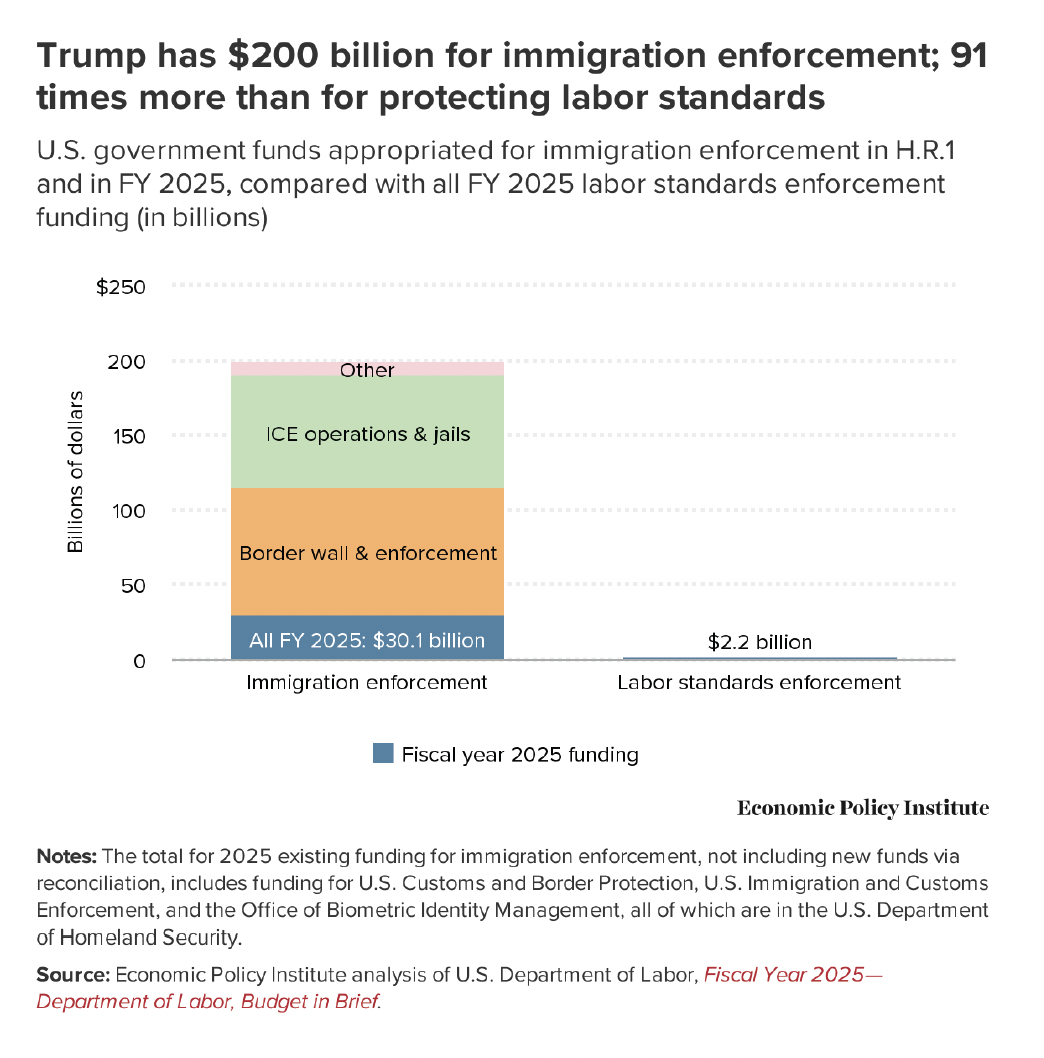
According to an analysis by the Economic Policy Institute (EPI), resources available for immigration enforcement are now an astonishing 91 times the resources available for labor enforcement. As shown in the chart below, the Trump-Vance administration has $200 billion available for Immigration and Customs Enforcement operations, including detention and border enforcement, among other Department of Homeland Security operations, while the federal labor enforcement agencies combined have a mere $2.2 billion. And these numbers do not even include the additional taxpayer dollars that the administration has spent on National Guard deployments and other federal agents that have been marshalled to assist with immigration enforcement operations. The Congressional Budget Office (CBO) estimates the costs of National Guard deployments over the last year was $496 million.
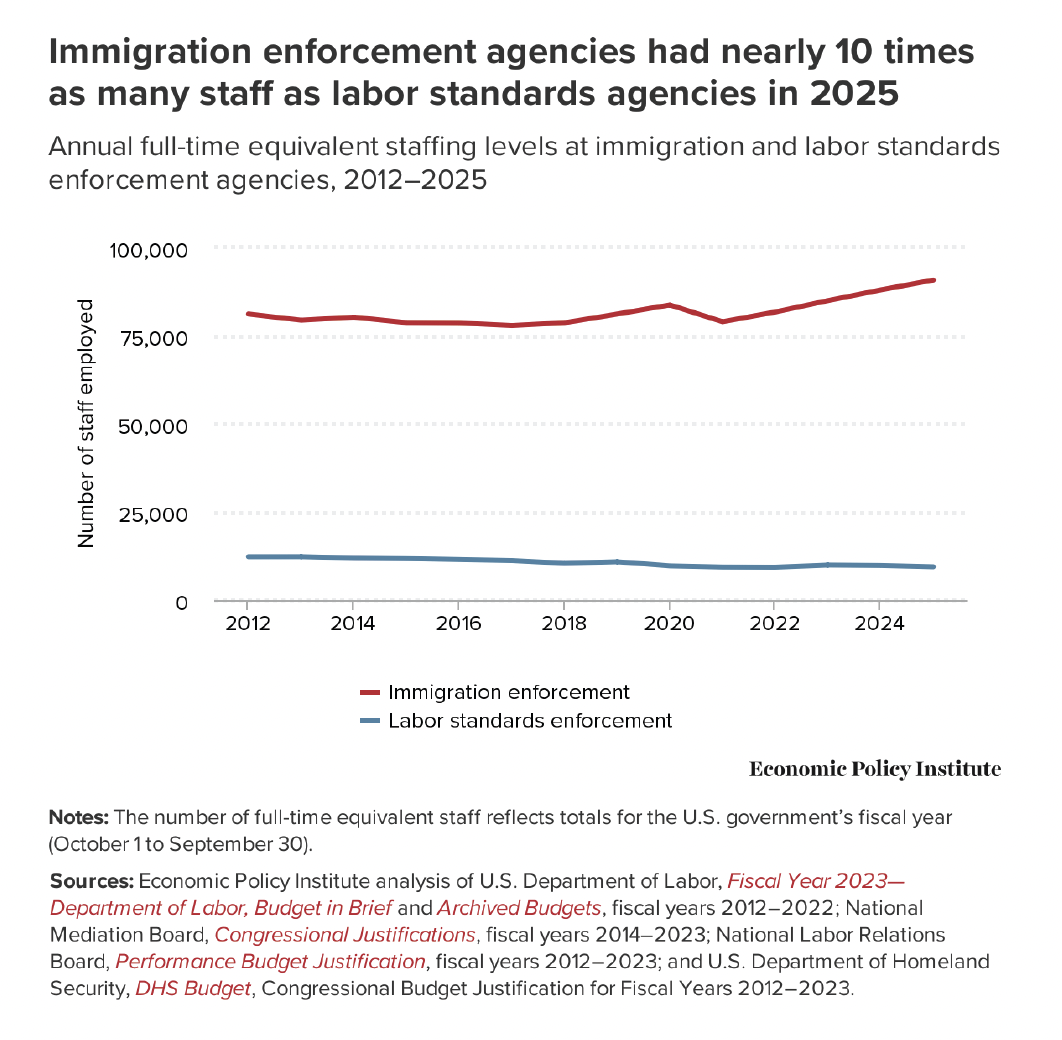
This surge in resources to immigration enforcement operations and depletion of resources to labor enforcement operations is reflected in the staffing dedicated to the respective operations, as well as the treatment of staff. According to an EPI analysis, staffing for immigration operations is now nearly 10 times the staffing for labor enforcement operations, and the disparity keeps growing wider.
ICE Staff is Surging
ICE has used its additional billions to go on a hiring surge. ICE has brought on 12,000 new agents, a 120% increase to its staff. To meet its goal, ICE offered signing bonuses of up to $50,000, promised student loan repayment and forgiveness options, and enhanced retirement benefits. ICE also has spent millions of dollars on advertising, including for those on online platforms like Facebook, Instagram, YouTube, Spotify and LinkedIn, as well as television ads. For one series of advertisements, ICE spent nearly $1 million on flashy truck upgrades and filmed the trucks being driven around Washington, D.C., for a video featuring a DaBaby song. There also were criticisms of ICE continuing to run these ads, spending millions of dollars during the government shutdown as most government employees were not being paid and needy families around the country went hungry as Supplemental Nutrition Assistance Program (SNAP) benefits began to lapse.
Federal Labor Enforcement Agencies Are Being Stripped of Staff
In contrast to the surge in spending on ICE recruitment efforts, staff at federal labor agencies have experienced dramatic loss through the administration’s shuttering or dismantling of whole agencies, reductions in force and voluntary early retirement incentives. This has far-reaching consequences, because reduced staffing means labor agencies have to make impossible choices about which cases to investigate and are less effective at enforcing the law. Enforcement agencies depend on personnel to carry out inspections, investigations, audits and follow-ups, but reduced staff means fewer labor enforcement actions, which weakens the credible threat of detection that drives employer compliance. Moreover, labor enforcement agencies with limited staffing cannot keep pace with cases even once violations are reported and identified; this stretches their capacity, and often makes it impossible for those labor agencies with the mandate to do proactive targeted investigations to do so.
A catastrophic exodus of Department of Labor (DOL) staff has threatened core aspects of working life.10 For example, DOL has lost at least 20% of its staff, with deep personnel reductions at the Bureau of International Labor Affairs (ILAB) and the Women’s Bureau (WB) and a stated goal of eliminating the Office of Federal Contract Compliance Programs (OFCCP).
President Trump’s failed Department of Government Efficiency (DOGE) made slash-and-burn cuts at OFCCP, the federal agency that ensured federal contractors are not engaging in discrimination. OFCCP’s workforce was slated to be reduced by about 90%, from roughly 479 employees down to about 50.11 For Fiscal Year 2026, the DOL has proposed eliminating OFCCP; President Trump already has rescinded Executive Order 1126 (which gave OFCCP its authority). The wholesale cuts at OFCCP are likely to hurt Black and women workers the most, but also will undermine decades of progress that expanded opportunity for disabled workers and veterans, which led to historic high employment levels for these communities.
The DOL’s Bureau of International Labor Affairs, which focuses on creating a fair global playing field for workers and businesses and improving working conditions worldwide, has also been gutted by the Trump-Vance administration. Given the administration’s plans to engage in massive cuts at the agency, the already-small division has seen a voluntary staff reduction of 40% to 50%. Reductions in staff size paired with the elimination of around $500 million in grants will harm U.S. workers because it will make it “easier for foreign companies to unfairly compete with businesses in the US” and harder for U.S. consumers to avoid products made with child labor. ILAB’s work helps level the playing field for U.S. workers competing in a global economy and these cuts could incentivize a race to the bottom for labor standards and conditions.
The DOL’s Women’s Bureau, devoted to advancing economic security and high-quality jobs for women, also has been cut to the bone, losing nearly 60% of its staff in 2025; it is slated for elimination in 2026. The elimination of the WB will mean that women will have less access to good jobs, particularly in “nontraditional” industries like construction, manufacturing and energy. This will also negatively impact the enforcement of DOL’s Wage and Hour Division (WHD) and OSHA, which use WB data to support their targeting in directed investigations.
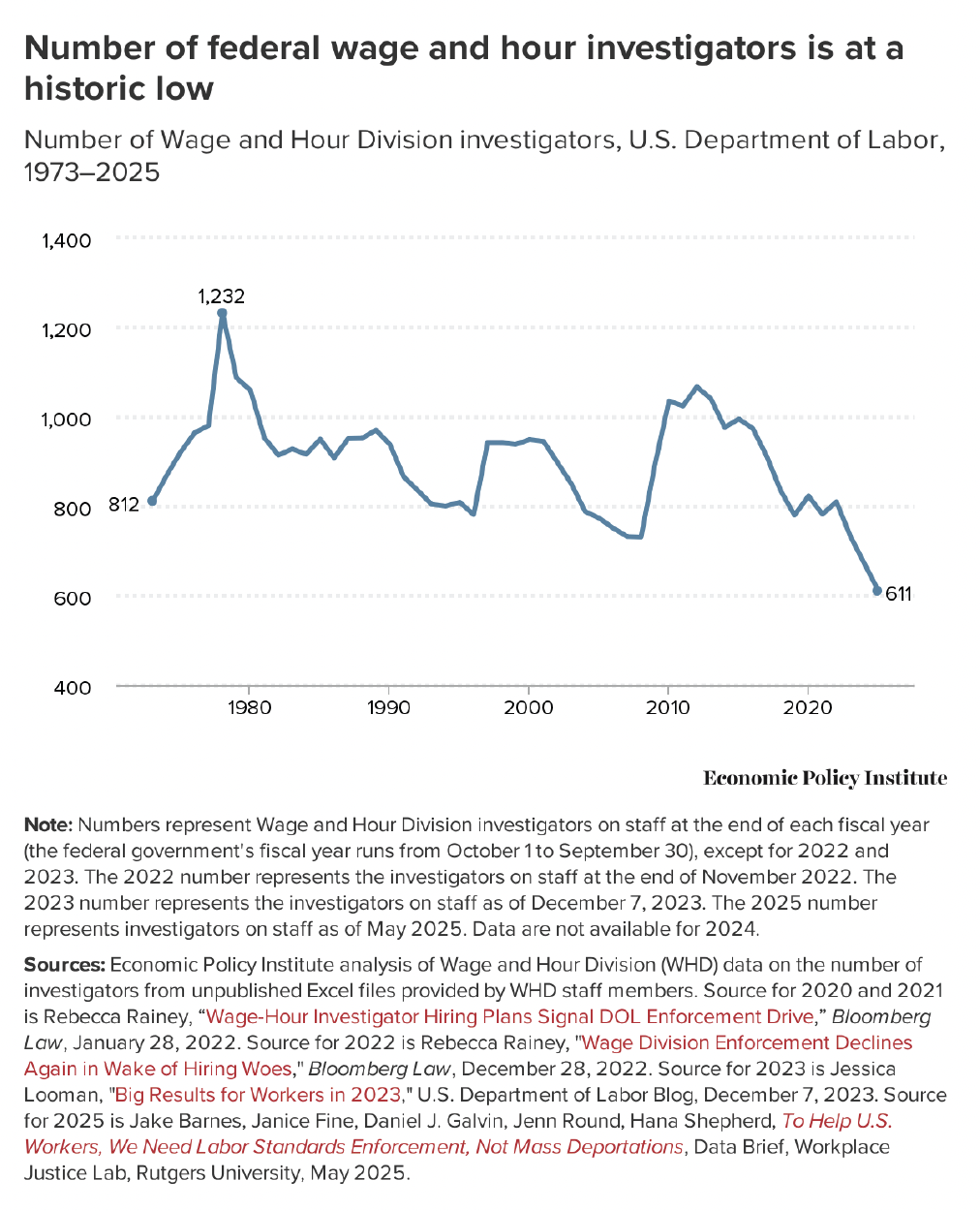
The unprecedented cuts at DOL come at a time when the agency already is approaching a historic low in terms of key staffing in vital enforcement agencies. At the start of 2021, the WHD had about 782 investigators protecting 165 million workers at 11 million workplaces nationwide. According to an analysis by the Economic Policy Institute, as of May 2025, this number had dropped to 611 investigators (see chart below). The WHD investigator workforce is at a historic low, despite substantial increases to the size of the workforce. This means there are fewer inspectors on the ground to enforce minimum wage, overtime, child labor and other protections, and widens the ratio of workers per investigator.
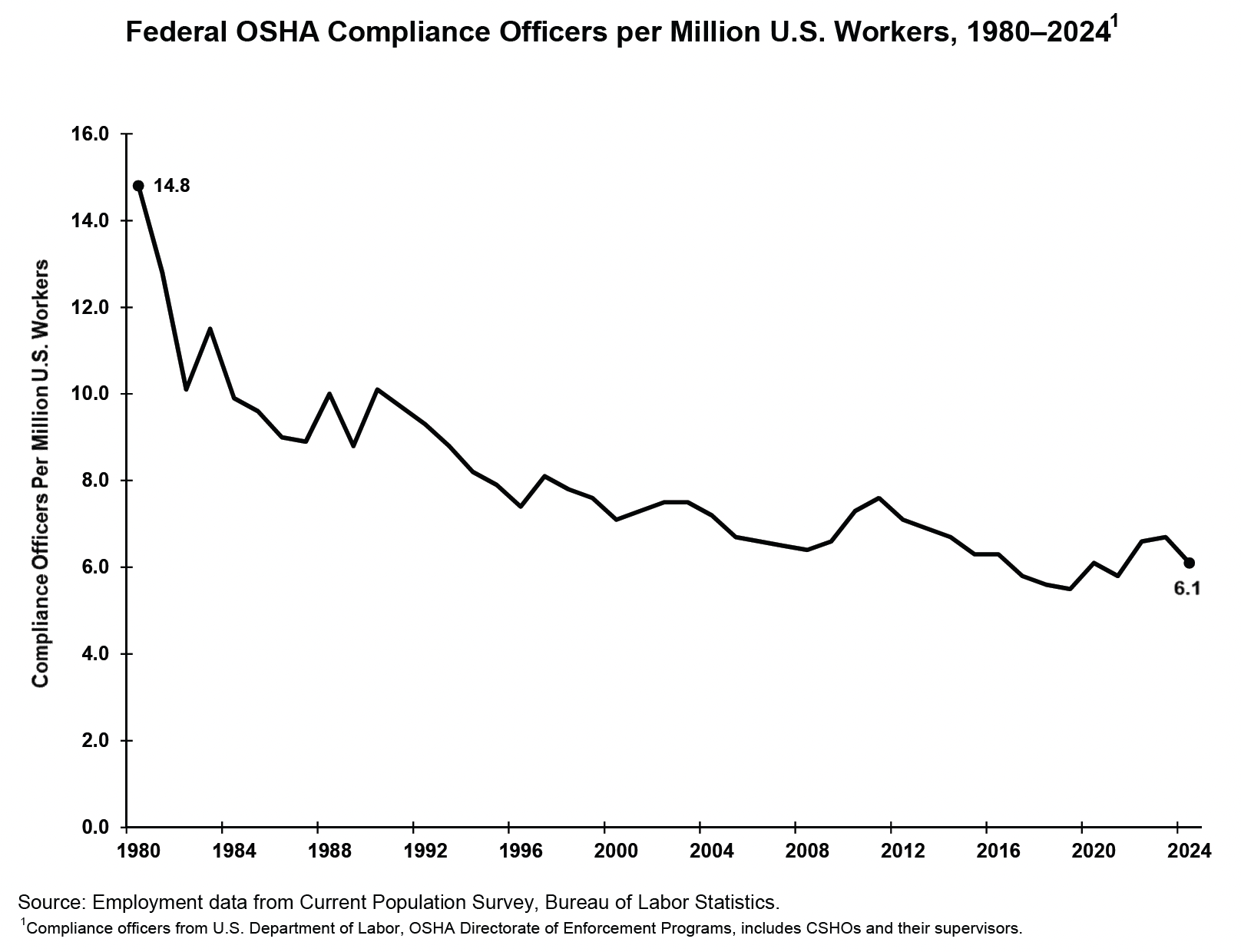
Similarly, OSHA resources remain woefully inadequate. In FY 2024, there were 1,802 inspectors (768 federal and 1,034 state) to inspect the 11.8 million workplaces under the agency’s jurisdiction, covering 161 million workers. In FY 2024, federal OSHA had 85 fewer inspectors than in FY 2023, meaning that OSHA now has one inspector for every 84,937 workers—and the agency has $3.92 available to protect each worker. The number of inspectors is even lower now with recent federal staff losses.
In addition, just seven days after the president was inaugurated, he removed NLRB member and former Chair Gwynne Wilcox, in violation of the text of the National Labor Relations Act (NLRA), which requires cause to remove a board member. The removal deprived the NLRB of a quorum and prevented the agency from making decisions and providing finality for union elections for more than 10 months. The efforts to incentivize NLRB employees to resign also have led to a significant loss in staff for an agency (close to 10%) that already was severely understaffed and underresourced.
The president also removed Equal Employment Opportunities Commission (EEOC) Chair Charlotte Burrows and member Jocelyn Samuels, undermining the EEOC’s ability to issue guidance and file litigation to protect workers from discrimination for nine months. New agency leadership at the Department of Justice’s Civil Rights Division has driven out more than 70% of staff. The administration additionally removed officials from other agencies involved in protecting workers’ rights, such as the Federal Labor Relations Authority (FLRA), the Merits Systems Protections Board (MSBP), the Office of Special Counsel (OSC) and the Federal Trade Commission (FTC). Even more severe, the administration has attempted to completely shut down other agencies involved in protecting workers’ rights, such as the National Institute for Occupational Safety and Health (NIOSH), the Federal Mediation and Conciliation Service (FMCS), the Consumer Financial Protection Bureau (CFPB), U.S. Agency for International Development (USAID) and the Department of Education.
The administration also has attacked labor agency employees’ collective bargaining rights and their status as career civil servants. On the first day of his administration, the president issued executive orders implementing a hiring freeze for labor agencies but not immigration enforcement agencies, removal of senior career employees’ civil service protections, and an end to all Diversity Equity and Inclusion (DEI) programs, among others. In the days after, labor agency employees received emails encouraging them to resign and directing them to report their colleagues involved in DEI efforts, and threatening the jobs of new employees. This was followed by labor agencies violating collective bargaining agreements, broad attacks on their unions and federal employee collective bargaining rights as a whole, and continued threats of mass firings, among other actions. Not only has the administration engaged in the largest union-busting sprees in U.S. history with its attacks on federal employee unions, it also has created psychological trauma for many federal employees, leading in some cases to employees taking their own lives.
All of these efforts have created an atmosphere of fear for labor agency employees and severely undermined staff morale. Whereas thousands of new ICE agents have been recruited, thousands of employees of labor protection agencies have been stripped of their rights and forced out of roles key to keeping our workplaces safe and fair.
Lack of Resources Undermining the Protection Our Communities and Workplaces Need
The lack of labor resources combined with the rollback of rules and policies that protect workers has done severe damage to labor enforcement efforts. This damage has been exacerbated by the surge in resources allocated to DHS, which has allowed DHS to invade our cities and quickly issue rules and policies that undermine workers’ rights.
Rolling Back Labor Protections and Their Enforcement
As described above, the administration has cut resources to the Department of Labor, shutting down programs and departments, and shedding labor protection regulations and enforcers. This has resulted in sharp declines in enforcement activity aimed at ensuring workers are paid in accordance with law, that they have safe workplaces and that they are not experiencing discrimination on the job. A recent report by Good Jobs First showed that the number of cases brought by the WHD and OSHA for labor offenses declined 52% from January to September versus the average for comparable periods over the last 17 years. The attempted destruction of agencies like NIOSH also has had tremendous consequences for workers’ health and safety.
The DOL also has rolled back rules put in place to protect workers. As documented in the AFL-CIO’s “Death on the Job: The Toll of Neglect” report, between January and April 2025, the administration delayed or abandoned rules put in place to protect workers from workplace hazards, such as the silica rule that would have protected mineworkers from severe occupational disease. And in July 2025, the DOL announced 64 initiatives to dismantle protections unions fought for decades to win. Last year, DOL also announced an expansion of employer self-auditing programs, which can exempt employers from inspections and allow employers to avoid penalties for breaking the law, and a directive to lower employer penalties that already are woefully inadequate for health and safety violations. The result will be weakening vital health and safety protections while removing employer accountability.
The National Labor Relations Board’s lack of quorum has resulted in the board’s complete inability to issue decisions. An accounting by The Guardian showed that, on average between January and December in 2021 through 2024, the NLRB issued 139 decisions. In 2025, that number went down more than 95%, with the board issuing just six decisions between Jan. 20 and Dec. 31, 2025. In addition, the NLRB’s acting general counsel rescinded 27 guidance memos that provided guidance to the public on fully effectuating the rights of workers under the National Labor Relations Act.
DHS’s Policies, Practices and Rules are Putting Workers in Physical and Financial Danger
As these labor agencies grapple with cuts to their budgets, mandates and staffing, DHS is compounding the harm by using its tremendous resources in a way that severely undermines labor standards enforcement. In some cases, immigration enforcers actually have targeted workplaces where there have been reports of labor violations and arrested victims of workplace exploitation, rather than the employers who are exploiting them. Here are a few examples of what that means in practice:
- In January 2025, ICE arrested and detained seven workers at Complete Autowash in Philadelphia and asserted in the press release they were there because the agency received “allegations employees were being subjected to labor exploitation.” There have been no public reports of DHS criminal enforcement against the employer of Complete Autowash, nor any reports of DOL enforcement on behalf of exploited workers.
- In September 2025, ICE conducted the largest worksite immigration enforcement action in history and arrested almost 500 workers at a Hyundai plant in Georgia, where an ICE official stated that the raid showed commitment to “protecting workers from exploitation.” Again, there have been no public reports of DOL enforcement against the corporation based on the allegations of worker exploitation, despite the fact that at least three workers were killed building the facility.
- In December 2025, Teamsters (IBT) Local 705 reported that CBP interrogated workers on a picket line. These workers had been on strike for more than a month to demand a fair contract, and an immigration check in such a moment runs a real risk of chilling concerted activity.
Such practices fly in the face of longstanding protocols between labor agencies and DHS that were meant to prevent immigration enforcement actions from interfering with the effective enforcement of labor and employment laws. Administrations of both parties long have recognized that labor standards enforcement is essential to ensuring fair wages and working conditions for all workers, and have taken steps to insulate that process from “inappropriate manipulation from other parties.
By contrast, the message of these recent actions targeting workers at workplaces where there are labor violations is clear: for the Trump-Vance administration, the “solution” to labor exploitation is the arrest and deportation of abused workers, while employers continue with business as usual. This creates an environment of impunity for abusive employers that puts all working people at risk.
Immigration enforcement efforts also have created workplace safety concerns, both for law enforcement and for those being affected by enforcement operations. As described by the Laborers’ Health & Safety Fund of North America, data shows immigration enforcement is correlated to a significant drop in the filing of safety complaints from workers and a dramatic spike in workplace injuries. Further, people have been injured and even died during chaotic immigration enforcement operations, including the recent high-profile killings of Renée Good and Alex Pretti. Safety concerns have been exacerbated by federal enforcement forces using masks or other disguises to hide their identities. As documented by the Center for American Progress, the use of masks to hide the identity of federal forces increases the risk of violent escalations, while also hindering accountability and eroding community trust.
“IUE-CWA’s LEAN program is creating more jobs in American manufacturing right here in Louisville, but deporting my co-workers just hurts my line and hurts GE’s ability to put out American-made appliances.”
DHS also has issued many new rules and policies that hurt workers. For example, DHS has stripped millions of workers of their work authorization through revoking temporary protected status (TPS) and humanitarian parole. These revocations have created tremendous disruption not only for the workers who previously had legal work authorization, but also for their workplaces, communities and unions. IUE-CWA workers at a GE plant in Louisville, Kentucky, spoke out after the Trump administration, without warning, revoked the legal immigration statuses of more than 150 IUE-CWA members at GE Appliances, causing the workers’ employment to be terminated without notice. Manufacturing lines were thrown into chaos with multiple team members suddenly missing from the line.
As described further below, the Trump administration and its DHS have issued rules that have suppressed wages for immigrant workers and their U.S. citizen counterparts in the fields; made it more difficult for international students and scholars to contribute to our universities and the local economies they anchor; and made it more difficult, or in some cases impossible, for immigrant employees to maintain their employment authorization documents and occupational licenses. While creating these obstacles for working people, Trump has allowed his wealthy friends to cut the line to immigrate to, or visit, the United States.
DHS also has used its resources to blitz communities across the country, from Los Angeles to Chicago to Memphis, Tennessee, to Charlotte, North Carolina, to New Orleans. Setting the stage for these blitzes, one of the first acts by ICE on Jan. 20, 2025, was to revoke its sensitive locations memo providing that it would not conduct operations at health care, educational and religious institutions, funerals or protests, among others. The revocation of this policy has been challenged by the American Federation of Teachers (AFT) and the National Education Association (NEA) in coalition with religious organizations and others,56 asserting that it creates undue risk both for students and for educators and others who serve the student population. However, it has not stopped ICE from invading these spaces to detain people.
In Chicago, ICE and CBP were heavily criticized for attacks on the media and religious leaders. They also were enjoined by a federal court from using rubber bullets and tear gas, without meeting court-imposed standards, after the Chicago News Guild (CNG) and NABET-CWA Local 41 sued them to protect their members. ICE was widely criticized also by labor unions, immigrants’ rights groups and elected leaders after detaining an employee of Rayito De Sol, a child care center in Chicago. ICE operations also have disrupted school communities around the country, in some situations affecting learning and causing reductions in student attendance.
ICE and CBP also have been challenged for engaging in profiling based on race, ethnicity, language and job classification; for arresting U.S. citizens; and for using violence such as breaking car windows and dragging people out of cars. Contrary to the administration’s claims to be targeting criminals, the administration has been criticized both for diverting resources away from criminal law enforcement efforts and for arresting people with no criminal background. In fact, recent data shows that in high-profile immigration enforcement operations in Chicago, Los Angeles, across Massachusetts and in Washington, D.C., more than half of those arrested had no criminal record—nor did about a third of people arrested by ICE between January and December 2025 nationwide.
The Trump-Vance Administration’s Misuse of Billions of Taxpayer Dollars
Billions of Taxpayer Dollars for Immigration Enforcement and Hollowing Out of Labor Enforcement is Causing Workers, Unions and the Economy to Lose
The data shows that in contrast to the Trump-Vance administration’s claims that their policies of mass deportation and eliminating government agencies will help American workers, this agenda is hurting workers and their unions, causing a loss of jobs, and disrupting critical supply chains and services.
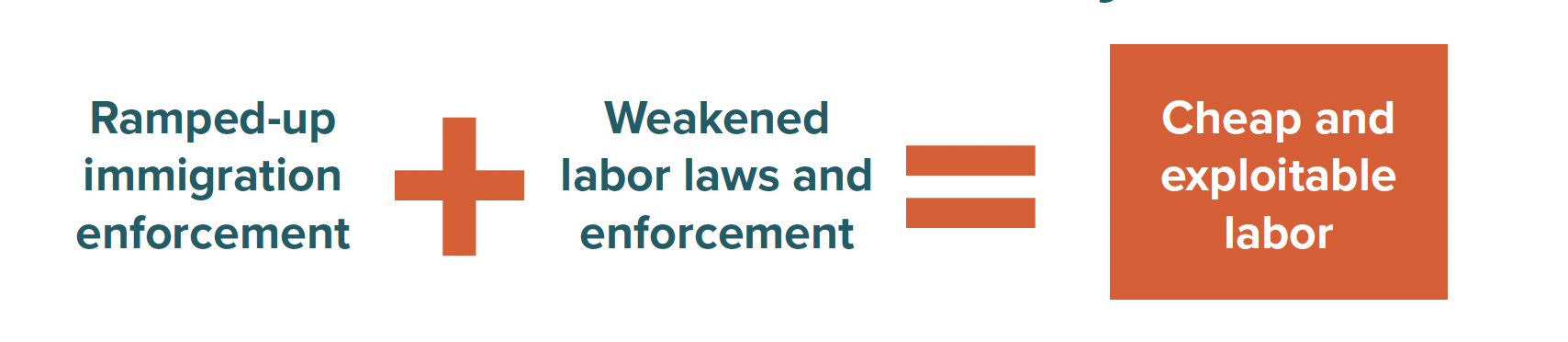
Anti-Worker, Anti-Union Playbook
With respect to the administration’s attack on labor protection agencies, it is no surprise that the DOL’s Wage and Hour Division has become less effective, and working people have suffered. For the first nine months of 2025, penalty totals for WHD dropped 83% from the average penalties during the same time period over the previous 17 years. The administration’s attack on WHD means “fewer compliance actions, investigations, and targeted inspections…” that result in fewer workers getting the “back wages they are entitled to by law” and causing economic calamity for working families threatening their “ability, jeopardizing these workers’ ability to pay for essentials such as rent, food, and child care.” It also means that employers will get away with billions of dollars of wage theft in many cases without consequence, that employers can underpay on their taxes (undermining our public services), and that employers can make it harder for law-abiding businesses to compete.
DOL’s Occupational Health and Safety Administration enforcement activity also has suffered under this administration, which will have major consequences for workplace safety. OSHA’s penalty totals dropped 47% over the first nine months of 2025 as compared with the same time periods over the previous 17 years. Workplace hazards kill approximately 140,000 workers each year (from both traumatic injury and occupational disease) and workers remain at serious risk of injury, illness or death as chemical plant explosions, major fires, construction collapses, infectious disease outbreaks, workplace assaults, toxic chemical exposures and other preventable tragedies continue to permeate the workplace. With reduced OSHA enforcement and a reduction in deterrent effects, which already are too low under current law, there likely will be increases in preventable workplace injury, disease and death.
With the loss of staff and quorum at the NLRB, and the attacks on federal workers, workers’ fundamental rights to organize and collectively bargain have been severely impacted. Studies show that unions are more popular than ever and that millions of nonunion workers want to be represented by a union, but face major obstacles in gaining that representation. The Trump-Vance administration’s policies have made it even more difficult.
For example, the attacks on the NLRB have resulted in fewer private sector workers being able to gain union representation through NLRB elections. Workers who won certification of a union plummeted from 93,419 from February through October 2024 to 47,576 from February through October 2025, a drop of nearly 50%. And even in cases where workers won certification of their union, because of the lack of quorum, employers could simply request review of certification or test the certification and know that the NLRB could not decide the case, leaving workers in limbo without the ability to actually bargain for better wages and working conditions. This is exactly what happened to workers at Whole Foods in Philadelphia who voted in favor of union representation by United Food and Commercial Workers (UFCW) Local 776 on Jan. 27, 2025. Whole Foods filed objections to the election, but these objections were overruled by the NLRB’s regional director, who certified the union as the representative in May 2025. Whole Foods then requested review by the full NLRB, and as of December 2025, the request was sitting in Washington, D.C., unable to be ruled on due to the NLRB’s loss of a quorum. In the meantime, workers have no legal recourse.
“Due to the fact that the NLRB isn’t functioning… we’re just waiting around."
With fewer unions being certified, and continued delays in processes at the NLRB, workers throughout the economy will feel the effects in their wages and working conditions, as fewer workers have union representation than they would if labor agencies were properly functioning and their rights were being protected. As demonstrated by economists, union workers have a union wage premium of about 10% to 15%, with larger effects for longer-tenured workers. But the effects go beyond wages. Union representation also narrows racial and gender wage gaps, provides greater access to employer-sponsored benefits—including health insurance, retirement and paid leave—strengthens workplace health and safety, and has a variety of positive effects on public services and democracy. And while we still don’t know the full effects of the rollback of worker protection rules across labor agencies, we do know millions of workers are losing protections against discrimination, wage theft and unsafe working conditions, which will further erode workplace standards.
“When the workers who are stepping up to try and reveal violations are silenced, the standard comes down for the whole industry.”
Trump’s immigration policies have exacerbated the harmful effects on workers as a result of the hollowing out of labor resources. As is well documented, when workers experience fear as a result of a hostile immigration enforcement environment, they are less likely to report labor violations, which results in very real effects on workplace standards for all workers. For example, Laura Garza, the director of the immigrant workers’ center Arise Chicago, recently explained that many of the workers her group assists are not interested at all in approaching the federal government right now, even if they’re being cheated out of pay. While Arise typically files several unfair labor practice charges with the National Labor Relations Board each year when workers think their rights have been violated, last year, it didn’t file any. And, as millions of workers are stripped of their work authorization, they are pushed into the shadow economy, where employers can exploit them and put downward pressure on wages and working conditions across the economy.
The administration’s new rules also have created downward pressure on wages and working conditions, and increases in prices to consumers. While the administration has ended TPS and other humanitarian pathways that allow immigrant workers to have mobility and exercise their rights, in January 2026, it announced it would expand the H-2B program, allowing up to an additional 64,716 workers to come to the United States this year through a program that creates a temporary, exploitable and underpaid workforce with negative effects on wages and working conditions for immigrant and U.S.-born workers alike. And in June 2025, the Department of Labor announced it no longer would enforce labor protections for farmworkers in the H-2A program who engaged in whistleblowing and organizing activity. Then, in October, the Department of Labor issued a rule immediately decreasing wages for these farmworkers. The Economic Policy Institute estimates the rule will lead to a total pay cut of $4.4 billion to $5.4 billion for U.S. farmworkers and farmworkers under the H-2A program. Ironically, the DOL justified the rule decreasing wages based on the administration’s own immigration policies, which it explained was creating a crisis in food supply chains, which could create food shortages and increase consumer prices.
Beyond the effects on wages and working conditions, Trump’s mass deportation agenda is creating disruption in our economy and is causing a loss of jobs for immigrant workers and U.S. citizens alike. The Economic Policy Institute estimates that if the administration follows through on its goals of deporting 4 million people over four years, it could destroy nearly 6 million jobs, with the deepest impact on the construction and child care workforce.
The administration’s attack on international students and scholars also is having devastating effects on colleges and universities, which in many cities and towns are the largest employer, providing jobs to a wide range of workers. With increased surveillance and targeting of international students based on their viewpoint, along with new rules that will interfere with their ability to complete their academic work or course of study and an ever-growing travel ban, it is no surprise that international student attendance has declined 17%. These declines threaten the economy of universities, as international students pumped nearly $44 billion into the American economy and generated 378,000 jobs last year alone, according to a major association of international educators.
The administration’s policies also have harmed other industries. Forbes reports that the United States is facing a shortfall of $25 billion to $29 billion this year in international visitor spending and risking millions of jobs in the hotel and hospitality industry. Hotels and restaurants also are being affected by losing workers and consumers, as a result of detention and deportation policies. The construction industry also has been disrupted by immigration enforcement, which threatens to eliminate nearly one in five jobs over the course of this administration. Targeting the residential construction workforce also could affect housing supply at a time when many places around the country already face a housing crisis.
The administration also is trying to strip 200,000 immigrant drivers of their commercial driver’s licenses (CDLs), which could cause significant disruption in public transportation (including to school), to logistics supply chains and to infrastructure maintenance. While this rule was stayed by the U.S. Court of Appeals for the D.C. Circuit pursuant to a challenge brought by AFSCME and AFT, the U.S. Department of Transportation is continuing to aggressively threaten states regarding their CDL programs and demand that they revoke drivers’ CDLs.
Finally, as described above, the Trump administration’s policies have caused significant disruptions in education, child care, direct care and health care. As described by the Washington Teachers’ Union (WTU/AFT) in its amicus brief filed in Molina v. DHS, the immigration enforcement operation in Washington, D.C., has traumatized children who have witnessed or heard about the arrests, or who have been separated from detained family members; caused widespread fear among students and families of leaving their homes, creating an attendance crisis in D.C. schools; and resulted in teachers and schools having to spend time and resources to ensure their students, especially Latino students, can learn. For example, teachers take time out of their day every day to manage or run carpools, accompany students to and from the bus or Metro, and organize neighborhood “walking buses” to ensure young students can walk safely to and from school.
Conclusion
The harm documented in this report can and must be stemmed by allocating resources and implementing policies that will lift workplace standards and benefit all workers and the economy. Doing so will require Congress to provide the resources needed for effective labor enforcement and to rein in the out-of-control spending on an immigration enforcement approach that is actively harming our communities, our workforce and our industries. It also will require a federal policy approach that lifts up labor standards by empowering all workers, regardless of immigration status, to report labor violations and organize with their co-workers for better wages and working conditions. State and local policymakers can take action also to protect workers in this environment. The below recommendations to federal and local lawmakers set out a policy agenda that will benefit the working people of this country.
Federal lawmakers should:
- Invest in real protections for workers: Provide robust increases in funding to the Department of Labor and its agencies like OSHA, the Mine Safety and Health Administration and Wage and Hour Division, the National Labor Relations Board, the Federal Labor Relations Authority, the National Mediation Board, the Federal Mediation and Conciliation Service, the National Institute for Occupational Safety and Health, and other agencies that protect workers and promote good, safe jobs.
- These agencies need to be resourced to provide the staff needed to adequately monitor and investigate workplace violations and enforce violations once identified.
- These agencies need to be resourced so they can create the rules, standards and recommendations needed to protect workers. Congress should ensure they are not using those resources to roll back worker protection rules.
- Congress should demand that independent labor agencies operate independently and conduct rigorous oversight of interference in statutory mission, structure and funding by the executive branch.
- Rescind unaccountable immigration spending: Rebalance our country’s investment priorities and stop funding immigration law enforcement operations that hurt workers, unions and the economy.
- The “One Big Beautiful Bill” provided unprecedented resources to the Department of Homeland Security to conduct enforcement without any meaningful guardrails. Congress must correct course and refuse to fund any further immigration enforcement that makes our communities and workplaces less safe and undermines our unions, industries and economy. Congress also should explicitly deny funding to issue or implement any rules that suppress wages and degrade working conditions.
- Congress should hold DHS accountable for abuses and ensure that immigration enforcement operations do not undermine labor enforcement operations through conducting rigorous oversight on how congressionally appropriated taxpayer dollars are causing harm in our communities and workplaces.
- Rein in federal abuses: Exercise legislative authority to check the overreach of federal agencies:
- Congress must act with urgency to stop abusive immigration enforcement practices, impose clear rules of engagement, and safeguard the rights of all members of our unions and communities.
- This must include measures to prevent the masking of agents, racial profiling stops, warrantless arrests, and enforcement at sensitive locations such as schools, hospitals and places of worship.
- Strengthen labor law protections: Raise wages, issue strong workplace safety and health standards, and protect workers against discrimination and retaliation, fund projects that provide good, safe jobs and insist that funding allocated be used for those purposes.
- Victims of workplace violations, including immigrant workers, need to be quickly compensated and immediately protected (through ensuring continued employment and no retaliation) so they can safely and effectively exercise their rights, report violations and participate in labor enforcement efforts.
- For years, there has been bipartisan support for coordination to ensure that law enforcement operations are not undermining each other, often referred to as deconfliction. Congress should codify these policies and hold agencies accountable for following them.
- Reinvigorate and restore labor agencies to their core, statutory missions:
- Direct the setting and enforcement of standards that protect workers, rather than employer voluntary or “self-audit” programs that exempt businesses from inspections and have no accountability for employers who violate the law.
- Restore and increase penalties—both maximums and minimums—and eliminate harmful default penalty reduction policies for employers who violate the law without specific settlement criteria that benefits workers.
- Raise the floor: Create immigration policies that lift standards for all workers by ensuring that employers cannot exploit immigrant workers.
- All workers should be able to safely exercise their labor rights, report violations and participate in labor enforcement efforts. This is not the case when workers are at risk of being stripped of their legal work authorization by the U.S. government, or are at risk of losing their work authorization at their employer’s whim, as is the case with guestworker programs. All immigrant workers who are working in the United States must have a path to citizenship and must have work authorization that is reliable and fully free of employer control.
State and local lawmakers should:
- Invest: Ensure that state and local labor law enforcement agencies that protect workers from wage theft, workplace hazards and discrimination have the resources they need.
- Just as for federal labor enforcement, for local labor enforcement to be effective, it must be funded and staffed.
- State and local labor enforcement should be provided funding to work collaboratively with labor unions, community organizations and workers’ rights litigators to educate workers about their rights under state and local law, and assist them with reporting violations.
- Innovate: States and localities can be a bulwark against federal inaction and aggression through innovative policies at the state and local level.
- State and local policies are always critical, but are even more so in a time when our federal labor law enforcement infrastructure is being dismantled. In 2025, state and local policymakers have passed laws expanding workers’ voice at work, increased resources and tools for state and local enforcers, including enlisting new enforcers, and enacted new labor standards. In 2026, state and local lawmakers should build on these initiatives.
- Expand access: Make labor enforcement processes safe and accessible for workers.
- During this time period in particular, labor enforcement agencies should provide safe alternatives for workers to participate in labor enforcement activities, including providing testimony remotely.
- State and local labor agencies also should also pursue deconfliction with immigration enforcement agencies where possible. For example, while in January 2025 ICE quickly moved to revoke its policy of using prosecutorial discretion for victims, witnesses and plaintiffs, it did say that “ICE officers and agents should coordinate and deconflict internally, and with local, state, and other federal law enforcement, as appropriate, when determining whether to take civil immigration enforcement actions to ensure criminal investigative and other enforcement actions will not be compromised.”
- Protect: Don’t let Trump’s DHS violate the safety of workers and our communities.
- Limit masking and require agency ID for all law enforcement in the state.
- Maintain clear separation of state and local law enforcement from federal immigration law enforcement.
- Create accountability task forces and hot lines to receive reports from members of the public regarding harms arising from federal deployments or immigration enforcement, in particular, and to provide support to impacted individuals.
- Pass policies that specifically protect immigrant workers’ rights, like protections against immigration related discrimination by employers and protections related to worksite immigration enforcement.
Acknowledgments and Endnotes
Acknowledgments: We are grateful to the Economic Policy Institute and The Movement Project, a joint initiative of Yale Law School and the International Refugee Assistance Project, for their contributions to this report.
1 See chart, infra.
2 Congressional Budget Office, “Estimating the Costs of Troop Deployments to U.S. Cities,” Jan. 28, 2026.
3 Department of Homeland Security, “ICE Announces Historic 120% Manpower Increase, Thanks to Recruitment Campaign that Brought in 12,000 Officers and Agents,” press release, Jan. 3, 2026.
4 Department of Homeland Security, “Secretary Noem Unveils No Age Limit for Patriotic Americans to Join ICE Law Enforcement to Help Remove Worst of the Worst from U.S.,” press release, Aug. 6, 2025.
5 Sarah Bregel, “ICE is Spending Millions on Ads to Recruit New Agents,” Fast Company, Dec. 16, 2025.
6 Thomas Beaumont and Rebecca Santana, “ICE airs ads stirring up local frustration to recruit police for mass deportation efforts,” Associated Press, Oct. 6, 2025.
7 Kelsey Reichmann, “ICE drops nearly $1 million on truck upgrades to attract recruits,” Courthouse News Service, Aug. 15, 2025.
8 Dan Goodling, “Trump Admin Spends Millions on ICE Ads as SNAP Runs Out of Money—Report,” Newsweek, Oct. 29, 2025.
9 Government Publishing Office, “Examining Regulatory and Enforcement Actions Under the Fair Labor Standards Act: Hearing Before the Subcomm. on Workforce Protections of the H. Comm. on Education and the Workforce,” 112th Congress, Serial No. 112–46, Nov. 3, 2011.
10 Michael Sainato, “Mass Resignations at Labor Department Threaten Workers in U.S. and Overseas, Warn Staff — as More Cuts Loom,” The Guardian, May 3, 2025.
11 David J. Santeusanio and Timothy Taylor, “A Look at Changes to Department of Labor Office of Federal Contract Compliance Programs,” Holland & Knight alert, March 10, 2025.
12 Department of Labor, “Fiscal Year (FY) 2026 Congressional Budget Justification, Volume 2: Office of Federal Contract Compliance Programs,” 2025.
13 Valerie Wilson and Sam Sanders, “Trump is making it easier for federal contractors to discriminate — and it will be underwritten by your tax dollars,” Economic Policy Institute, Working Economics Blog, May 27, 2025; National Women’s Law Center, “Workers Rights Organizations Condemn the Dismantling of Workplace Civil Rights Enforcement Agency,” April 17, 2025.
14 Sainato, supra note 10.
15 Id.
16 Courtney McManus, “Duckworth Joins Schatz, Murray, Colleagues Condemning Labor Department’s Cancellation of Funding to Address Child Labor, Human Trafficking Worldwide,” Riverbender.com, April 24, 2025.
17 Anna Del Savio, “White House Targets Women’s Bureau for Elimination,” Northwest Labor Press, June 5, 2025.
18 AFL-CIO, “Death on the Job: The Toll of Neglect, 2025,” April 23, 2025.
19 Id.
20 Sharon Block, “Trump Puts NLRB Independence on the Line,” OnLabor, Feb. 10, 2025.
21 Michael Sainato, “A very hostile climate for workers’: US labor movement struggles under Trump,” The Guardian, Dec. 14, 2025.
22 Matthew Goldstein and Emily Steel, “Trump Fired E.E.O.C. Commissioners in Late-Night Purge,” The New York Times, Jan. 28, 2025.
23 Ryan Lucas, “70% of the DOJ’s Civil Rights Division lawyers are leaving because of Trump’s reshaping,” NPR, May 19, 2025.
24 Josh Eidelson, “How Trump Broke Corporate America’s Most Valuable Consultant,” Bloomberg Businessweek, Sept. 18, 2025.
25 Parker Purifoy and Elias Schisgall, “Federal Mediation Services’ Future Dim Despite Workers’ Return,” Bloomberg Law, July 2, 2025.
26 Economic Policy Institute, “Trump administration attempts to close the CFPB, block agency’s work,” Federal Policy Watch, Nov. 19, 2025.
27 Kelly M. Fay Rodriguez, “Trump’s Anti-Worker Foreign Policy,” Foreign Policy, Oct. 24, 2025.
28 Randi Weingarten, “Trump’s Education Department crusade is a cowardly betrayal of America’s children,” MS Now, March 11, 2025.
29 The White House, “Hiring Freeze,” Presidential Action, Jan. 20, 2025.
30 The White House, “Restoring Accountability to Policy-Influencing Positions Within the Federal Workforce,” Presidential Action, Jan. 20, 2025.
31 The White House, “Ending Radical And Wasteful Government DEI Programs And Preferencing,” Presidential Action, Jan. 20, 2025.
32 Hannah Natanson and Meryl Kornfield, “The year Trump broke the federal government,” The Washington Post, Dec. 21, 2025.
33 See, e.g., AFGE, “Union Decries Administration Move to Fire Labor Department Workers,” press release, May 12, 2025; Parker Purifoy, “Labor Board
Details Return to Office Plan in Memo to Staff,” Bloomberg Law, Feb. 26, 2025.
34 AFGE, “Summary of AFGE Lawsuits against Trump & How Litigation Works,” Dec. 22, 2025.
35 Patrick Oakford and Margaret Poydock, “Trump is the biggest union-buster in U.S. history,” Economic Policy Institute, Working Economics Blog, Sept. 2, 2025.
36 William Wan and Hannah Natanson, “White House officials wanted to put federal workers ‘in trauma.’ It’s working,” The Washington Post, May 20, 2025.
37 Siobhan Standaert, “Worker Protections in Freefall: The Collapse of Federal Labor Enforcement under the Second Trump Administration,” Good Jobs Now, December 2025.
38 See Eidelson supra note 24.
39 “Death on the Job: The Toll of Neglect, 2025,” supra note 18 at 17–18.
40 Department of Labor, “US Department of Labor launches self-audit programs to help regulated community strengthen compliance with federal labor
laws,” press release, July 24, 2025.
41 See, e.g., Economic Policy Institute, “Department of Labor restarts employer-friendly ‘self-audit’ compliance program on wage and hour laws,” Federal Policy Watch, July 25, 2025.
42 Department of Labor, “US Department of Labor updates penalty guidelines to support small businesses and eliminate workplace hazards,” press release, July 14, 2025.
43 Julie Su, Rachel West and Andrew Stettner, “Trump’s Department of Labor Continues Its Onslaught against Workers,” The Century Foundation, July 22, 2025.
44 Sainato, supra note 21.
45 National Labor Relations Board, “Rescission of Certain General Counsel Memoranda,” Memorandum GC 25-05 dated Feb. 14, 2025, available at https://apps.nlrb.gov/link/document.aspx/09031d4583f3f58c.
46 Immigration and Customs Enforcement, “ICE Philadelphia arrests 7 in worksite enforcement operation,” press release, Jan. 31, 2025.
47 CBS News, “475 people detained in Georgia Hyundai raid by ICE, other agencies, officials say,” Sept. 6, 2025.
48 Alaa Elassar, Isabel Rosales and Caroll Alvarado, “Inside the raid: How a monthslong federal immigration operation led to 475 arrests at a Hyundai plant in Georgia,” CNN, Sept. 5, 2025.
49 Dave Jamieson, “Border Agents ‘Interrogated’ Striking Workers In Chicago, Teamsters Say,” HuffPost, Dec. 17, 2025.
50 Department of Labor and Department of Homeland Security, “Revised Memorandum of Understanding between the Departments of Homeland Security and Labor Concerning Enforcement Activities at Worksites,” Dec. 7, 2011.
51 Laborers’ Health & Safety Fund of North America, “Immigration Enforcement Threatens Workers Safety & Health,” Aug. 30, 2025.
52 Jon Schuppe and Erik Ortiz, “Trump’s DHS has shot 11 people during immigration enforcement operations since September. Here’s what to know.,” NBC News, Jan. 16, 2026.
53 Allie Preston, “Masked and Unidentifiable: The Risks of Federal Law Enforcement Operating Without Identification,” Center for American Progress, Aug. 28, 2025.
54 Communications Workers of America, “IUE-CWA Members Featured on CBS Evening News,” press release, Oct. 2, 2025.
55 Matthew Lee, “US prioritizes visas for fans traveling for the World Cup, Olympics and other events,” Associated Press, Dec. 4, 2025.
56 Moriah Balingit, “Teachers sue over Trump’s immigration crackdown, saying students are staying home,” Associated Press, Sept. 10, 2025.
57 Dylan Manshack, “RELEASE: Federal judge orders DHS/ICE to halt arrests and use of chemical weapons on Chicago press, peaceful protestors,” The NewsGuild-CWA, Oct. 9, 2025.
58 SEIU HCII, “Invest in Care, Not Cruelty”: Chicago Child Care Workers, Parents, Elected Officials Demand Accountability After ICE Raid at Rayito De Sol Daycare,” Nov. 6, 2025.
59 See e.g., Ileana Najarro and Alex Harwin, “The Widespread Effects of Immigration Enforcement on Schools, in Charts,” EducationWeek, Nov. 24, 2025.
60 Gabriel R. Sanchez and Edward D. Vargas, “Racial profiling by ICE will have a marked impact on Latino communities,” Brookings, Oct. 16, 2025.
61 Nicole Foy, “We Found That More Than 170 U.S. Citizens Have Been Held by Immigration Agents. They’ve Been Kicked, Dragged and Detained for Days,” ProPublica, Oct. 16, 2025.
62 Nicole Foy and McKenzie Funk, “‘We’ll Smash the Fucking Window Out and Drag Him Out,’” ProPublica, July 31, 2025.
63 Beth Schwartzapfel, “For Trump Administration, Fighting Crime Takes a Backseat to Immigration Arrests,” The Marshall Project, Oct. 4, 2025.
64 Albert Sun, “Most Immigrants Arrested in City Crackdowns Have No Criminal Record,” The New York Times, Dec. 4, 2025.
65 Standaert, supra note 37.
66 Julie Su, “What Cuts to the Department of Labor Will Mean for You,” The Century Foundation, April 3, 2025.
67 Jake Barnes et al., “To Help U.S. Workers, We Need Labor Standards Enforcement, Not Mass Deportations: Data Brief,” Workplace Justice Lab, May 2025.
68 Standaert, supra note 37.
69 “Death on the Job: The Toll of Neglect, 2025,” supra at note 20.
70 Emma Cohn and Jennifer Sherer, “Too many workers die on the job every year. Trump’s attacks on OSHA will kill more,” Economic Policy Institute, Working Economics Blog, April 25, 2025.
71 Margaret Poydock, Celine McNicholas, Jennifer Sherer and Heidi Shierholz, “16 million workers were unionized in 2024—Millions more want to join unions but couldn’t,” Economic Policy Institute, Jan. 28, 2026.
72 Union certification data, available at NLRB.gov/reports/graphs-data/certification-of-case-representative-monthly-reports/2026.
73 Case 04–RC–355267 Whole Foods Market Group, Inc., available at NLRB.gov/case/04-RC-355267.
74 Sainato, supra note 21.
75 Laura Feiveson, “Labor Unions and the U.S. Economy,” Department of the Treasury, Aug. 23, 2023.
76 Celine McNicholas, Margaret Poydock, Heidi Shierholz and Hilary Wething, “Unions aren’t just good for workers—they also benefit communities and democracy,” Economic Policy Institute, Aug. 20, 2025.
77 Amanda M. Grittner and Matthew S. Johnson, “When Labor Enforcement and Immigration Enforcement Collide: Deterring Worker Complaints Worsens Workplace Safety,” W.E. Upjohn Institute for Employment Research Working Paper no. 21–353, October 2021.
78 Dave Jamieson, “A Construction Workers Union Faces Its Most Divisive Issue: Immigration,” HuffPost, Dec. 23, 2025.
79 Id.
80 Sarah Anderson and Reyanna James, “Four Charts on Immigration Exploitation in America,” Inequality.org, April 3, 2025.
81 Sarah Lazare, “How Trump’s Immigration Crackdown Chills Organizing and Erodes Conditions for All Workers,” Workday Magazine, Jan. 15, 2026.
82 U.S. Citizenship and Immigration Services, “Temporary Increase in H-2B Nonimmigrant Visas for FY 2026,” last visited Feb. 4, 2026.
83 Daniel Costa and Josh Bivens. “The H-2B visa program has ballooned without being fixed. Expanding it to year-round jobs like meatpacking would lower wages and revenue,” Economic Policy Institute, Sept. 18, 2025.
84 Economic Policy Institute, “Department of Labor halts enforcement of expanded labor protections for migrant farmworkers on H-2A temporary visas,” Federal Policy Watch, June 24, 2025.
85 Department of Labor, “Adverse Effect Wage Rate Methodology for the Temporary Employment of H-2A Nonimmigrants in Non-Range Occupations in the United States,” 90 Fed. Reg. 47914–47963, Oct. 2, 2025.
86 Ben Zipperer, “Trump’s deportation agenda will destroy millions of jobs,” Economic Policy Institute, July 10, 2025.
87 Lisa Femia, Sophia Cope and Saira Hussain, “Trump Administration’s Targeting of International Students Jeopardizes Free Speech and Privacy Online,” Electronic Frontier Foundation, April 25, 2025.
88 Stuart Anderson, “Trump Deals A New Immigration Blow To International Students,” Forbes, Aug. 28, 2025.
89 Asian Law Caucus, “Understanding Trump’s Travel and Immigration Bans,” Jan. 20, 2026.
90 Alan Blinder, “New International Student Enrollments Plummeted This Fall, Survey Finds,” The New York Times, Nov. 17, 2025.
91 National Association of International Educators, “International Students Contribute Record-breaking Level of Spending and 378,000 Jobs to the U.S. Economy,” press release, Nov. 18, 2024.
92 Suzanne Rowan Kelleher, “U.S. Tourism Will Lose Up To $29 Billion As Visitors Plummet Amid Trump Policies,” Forbes, July 3, 2025.
93 See, e.g. Michael Adkison, “Trump’s policies are hurting Texas restaurants, new report shows,” Houston Public Media, Oct. 31, 2025.
94 See, e.g., Lise Kiennemann, ‘Empty building sites’: North Carolina immigration crackdown sparks fear among workers,” France 24, Nov. 28, 2025.
95 Jorge González-Hermoso, Christina Plerhoples Stacy and Hamutal Bernstein, “Mass Deportations Would Worsen Our Housing Crisis,” Urban Institute, Feb. 25, 2025.
96 AFSCME, “Court Halts Trump Rule Targeting the Livelihood of Immigrants Pending Appeal,” press release, Nov. 14, 2025.
97 Josh Funk, “Feds threaten funding to California, seven other states over commercial driver’s licenses for immigrants,” Los Angeles Times, Dec. 13, 2025.
98 American Immigration Council, “Immigrant Workers and the Childcare Crisis,” Dec. 11, 2025.
99 Ben Zipperer, “Trump’s deportation plans threaten 400,000 direct care jobs,” Economic Policy Institute, Working Economics Blog, Dec. 15, 2025.
100 Washington Teachers’ Union, Amicus brief in Molina v. DHS, Case 25–cv–03417 (D.D.C.), Oct. 28, 2025.
101 See, e.g., Rachel Deutsch and Terri Gerstein, “Power in partnership: How government agencies and community partners are joining forces to fight wage theft,” Economic Policy Institute and Center for Labor & a Just Economy at Harvard Law School, June 8, 2023.
102 Terri Gerstein, “Issue Brief: 2025 State workers’ rights roundup,” NYU Wagner Labor Initiative, Oct. 30, 2025; see also Julie Su and Rachel West, "How States Can Lead the Way for Workers: A State Playbrook,” The Century Foundation, Nov. 10, 2025.
103 Caleb Vitello, “Interim Guidance on Civil Immigration Enforcement Actions Involving Current or Potential Beneficiaries of Victim-Based Immigration Benefits,” Immigration and Customs Enforcement memo, Jan. 30, 2025.
104 See, e.g., Marisa Díaz and Mimi Whittaker, “How States and Localities Can Strengthen Workplace Protections for Immigrant Workers,” National Employment Law Project, Jan. 15, 2026.